
Blog
Fair Market Value vs Orderly Liquidation Value: Which Heavy Equipment Appraisal Do You Need?
Orderly liquidation value vs fair market value equipment appraisals answer different questions, and picking the wrong one can sink a loan application or a bankruptcy filing. This guide maps each value premise to the real-world scenario it's built for so you request the right report the first time.
A bank underwriter, a bankruptcy trustee, and a private buyer can all ask for an appraisal on the same excavator and expect three different numbers. That's not sloppy work; it's because "value" isn't one thing. Fair market value, orderly liquidation value, forced liquidation value, and replacement cost each describe a different transaction scenario, and the number changes depending on which one applies. Getting this wrong wastes money on the wrong report and can get a submission rejected by a lender or court that asked for something specific.
Our heavy equipment appraisal services start every engagement by pinning down which value premise the assignment actually calls for, because the rest of the analysis depends on it. This guide walks through each premise, the real-world situation it's designed for, and why the appraiser has to name the definition being used rather than assume the reader already knows.
What Is Fair Market Value for Heavy Equipment?
Fair market value is the price a piece of equipment would bring in a sale between a willing buyer and a willing seller, neither one under pressure to act, both reasonably informed about the asset and the market. It's the default premise for a straightforward sale between private parties: a contractor selling a used loader to another contractor, or a farm liquidating a tractor outside of any distress.
This premise assumes normal market exposure. The seller isn't in a hurry, the buyer isn't desperate, and both sides have had a reasonable chance to inspect the machine and check comparable sales. It's the value most people picture when they hear "appraisal," and it's the right call for estate filings, gift and donation reporting, and negotiated sales where neither party is under duress.
Fair Market Value in Continued Use
A related but distinct premise is fair market value in continued use. This applies when equipment is being valued as part of an operating business, not as a standalone asset for sale. A machine shop being sold as a going concern needs its CNC equipment valued as productive assets contributing to an income stream, installed and running, not as items pulled off the floor and sold individually.
Example: A manufacturing business sale includes $2 million in production equipment. Valued in continued use, that equipment supports the plant's ongoing output and carries a higher value than the same machines would fetch if sold piecemeal after the plant closed.
What Is Orderly Liquidation Value?
Orderly liquidation value is the gross amount typically realizable when a seller is compelled to sell but still has a reasonable window, commonly cited as roughly three to six months, to find buyers, advertise the equipment, and complete transactions on an as-is, where-is basis. The seller doesn't get to wait for the ideal buyer, but the sale isn't a fire drill either.
This is the premise most often requested for planned equipment retirements and for bank or SBA collateral lending. A lender extending a loan secured by heavy equipment wants to know what it could recover if the borrower defaulted and the bank had to liquidate the collateral through a reasonably managed process, not a same-week auction. Because equipment financed through Small Business Administration programs is frequently valued this way, an orderly liquidation appraisal is often a standard part of the loan file, and general lending resources describe used equipment valuation for financing purposes in similar terms according to the Business Development Bank of Canada's guidance on used equipment valuation.
Orderly liquidation value is typically lower than fair market value, because compulsion, a defined marketing window, and as-is sale terms all reduce what a buyer is willing to pay. That gap isn't a fixed percentage; it depends on the specific machine, its condition, the depth of the buyer pool, and how the assumed exposure period compares to normal market timing for that asset class.
Forced Liquidation Value: When the Clock Is Compressed
Forced liquidation value assumes an immediate or highly compressed sale, the kind ordered by a bankruptcy court on a tight deadline or demanded when a note holder needs cash fast. There's no meaningful marketing period. The sale might happen through a properly advertised auction, but the compulsion factor and the short timeline are what separate it from orderly liquidation.
It's worth noting that an auction sale doesn't automatically equal forced liquidation value. A well-attended, well-advertised auction for desirable equipment can produce prices close to fair market value; a rushed sale with little notice can produce prices well below it. The appraiser has to evaluate the actual circumstances of the sale rather than assume the sale method dictates the value premise.
Replacement Cost: The Insurance Premise
Replacement cost answers a different question entirely: what would it cost to replace this equipment today with something of similar capability, new or comparably functional? This is the premise insurers rely on for coverage decisions and for settling total-loss or damage claims, because the policy is generally designed to make the owner whole in terms of operating capacity, not to model a hypothetical sale.
Unlike the other three premises, replacement cost isn't concerned with what a buyer and seller would agree to. It's an engineering and market-pricing exercise: current cost to acquire or build an equivalent asset, adjusted for depreciation where the policy calls for it.
Why USPAP Doesn't Define These Terms for You
Here's the detail that trips up a lot of equipment owners: the Uniform Standards of Professional Appraisal Practice, published by The Appraisal Foundation, sets the rules for how an appraisal is conducted and reported. It does not hand appraisers a glossary of value premises. Those definitions come from elsewhere: professional organizations such as the American Society of Appraisers publish standard definitions of value that the equipment appraisal industry relies on, and the party requesting the appraisal (a lender, a court, an insurer, a trustee) often specifies which definition applies to their assignment.
Because the definition isn't fixed by USPAP itself, a compliant report has to state, in plain language, exactly which value premise was used and where that definition came from. A report that just says "fair market value" without identifying the source of that definition leaves the reader guessing whether it matches what the bank, court, or insurer actually needed. Our appraisers hold credentials with organizations including the ASA, CAGA, and NEBB, and every report we prepare states the value premise and its source up front, before the analysis begins.
The underlying analysis techniques stay consistent across premises even when the assumptions change. Appraisers typically rely on a sales-comparison approach, a cost approach, or an income approach depending on the asset and the assignment, a distinction covered in more depth in our overview of the four methods of valuation. What shifts between FMV, OLV, FLV, and replacement cost isn't the method so much as the market conditions, timeline, and sale terms the appraiser is asked to assume.
Comparing Value Premises Across Common Scenarios
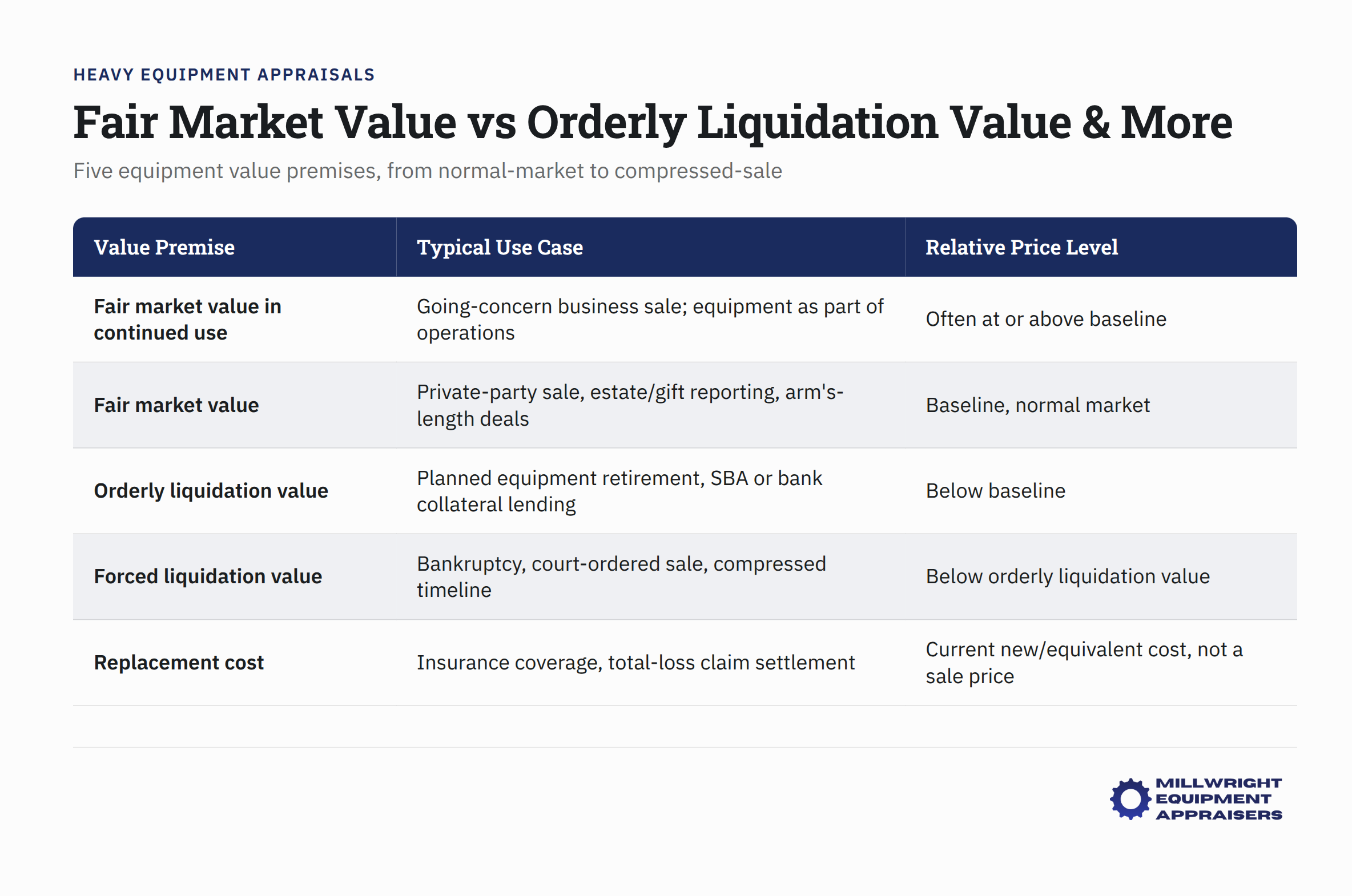
The table below maps each value premise to the situation it's built for and how it typically compares in price level to a normal-market sale.
| Value premise | Typical use case | Relative price level |
|---|---|---|
| Fair market value | Private-party sale, estate or gift reporting, arm's-length transactions | Baseline, normal market |
| Fair market value in continued use | Going-concern business sale, equipment valued as part of operations | Often at or above baseline |
| Orderly liquidation value | Planned equipment retirement, SBA or bank collateral lending | Below baseline |
| Forced liquidation value | Bankruptcy, court-ordered sale, compressed timeline | Below orderly liquidation value |
| Replacement cost | Insurance coverage, total-loss claim settlement | Reflects current new or equivalent cost, not a sale price |
How This Plays Out in SBA and Bank Lending
A bank financing a piece of heavy equipment isn't primarily asking "what would this sell for between two happy parties." It's asking "what could we recover if this loan went bad." That's why collateral analysis for equipment-backed SBA and conventional loans so often specifies orderly liquidation value rather than fair market value: the lender wants a realistic recovery estimate under a compelled sale, not an optimistic one under ideal conditions.
Watch out: Submitting a fair market value appraisal when the lender's file requires orderly liquidation value is a common and avoidable delay. Confirm the required premise with the lender or loan officer before ordering the report.
Fees for heavy equipment appraisals are quoted as a fixed price after we scope the assignment, based on factors like the number of units, the complexity of the equipment, and whether the report needs to meet IRS-qualified standards or a standard reporting format. They're never based on the value of the equipment itself or billed by the hour.
Choosing the Right Value Premise Before You Order
The fastest way to get a usable report is to identify who's asking for it and why before the appraiser starts work. A private sale calls for fair market value. A going-concern business sale calls for fair market value in continued use. A bank, SBA lender, or planned retirement calls for orderly liquidation value. A bankruptcy court on a short deadline calls for forced liquidation value. An insurance policy calls for replacement cost.
If you're not sure which premise your situation requires, ask the institution making the request rather than guessing. Our team can also help confirm the right scope before work begins. Request a heavy equipment appraisal and we'll pin down the correct value premise as part of scoping your assignment.
This article is provided for general informational purposes only and does not constitute legal, tax, or financial advice. Readers should consult a qualified attorney or CPA regarding their specific circumstances.