
Blog
How Hours and Condition Grading Actually Change Your Heavy Equipment Appraisal Value
Operating hours are only a starting point for answering how hours affect heavy equipment value; condition grading, inspection findings, and comparable sales do the real work. This guide gives owners a framework, and a checklist, for sanity-checking a machine's value before a formal appraisal.
If you own heavy equipment and you've ever pulled up an auction result for a "similar" machine, you've probably noticed the prices don't line up the way the hour meters suggest they should. A 6,000-hour excavator sells for more than a 4,500-hour one. A low-hour loader gets passed over at auction while a higher-hour unit draws strong bids. None of that is a fluke. Hours are only one input into value, and on their own they don't tell an appraiser, or a buyer, much of anything.
This guide walks through how our heavy equipment appraisal service actually weighs hours against condition, what we physically inspect to assign a condition grade, and how those findings get reconciled against comparable sales to land on a defensible number. At the end, you'll have a practical checklist for sanity-checking your own machine before you commission a formal appraisal.
Why the Hour Meter Is Only a Starting Point
The hour meter tells you how long the engine has run. It does not tell you how the machine was used, how well it was maintained, or even whether the number on the dash is accurate.
Meters get swapped during component replacements, disconnected during long repairs, or simply fail and get replaced without a reset. Reported hours can also be manipulated or poorly recorded, which is exactly why inspection evidence matters more than a dashboard reading, according to heavy equipment depreciation research. A machine showing 3,200 hours that has clearly worked harder than that number suggests is a red flag, not a selling point.
The way to catch a mismatch is to check wear points against the stated hours:
- Pedal and control wear: Heavily worn foot pedals, armrests, and joystick boots on a "low-hour" machine suggest more use than the meter admits.
- Seat condition: A collapsed or heavily worn operator seat on a unit with supposedly light hours is a mismatch worth questioning.
- Pin and bushing play: Excessive movement at bucket, boom, and stick pins accumulates with real working hours, not meter hours.
- Track and undercarriage wear: Undercarriage wears on a fairly predictable curve relative to hours; a track that's worn well beyond what the meter implies is one of the clearest tells of a rolled-back or replaced meter.
If these wear indicators don't match the hour reading, the appraiser adjusts the assumed utilization rather than taking the meter at face value. This is standard due diligence, not an accusation, since meters fail mechanically far more often than owners misrepresent them on purpose.
The Condition Categories Appraisers Actually Use
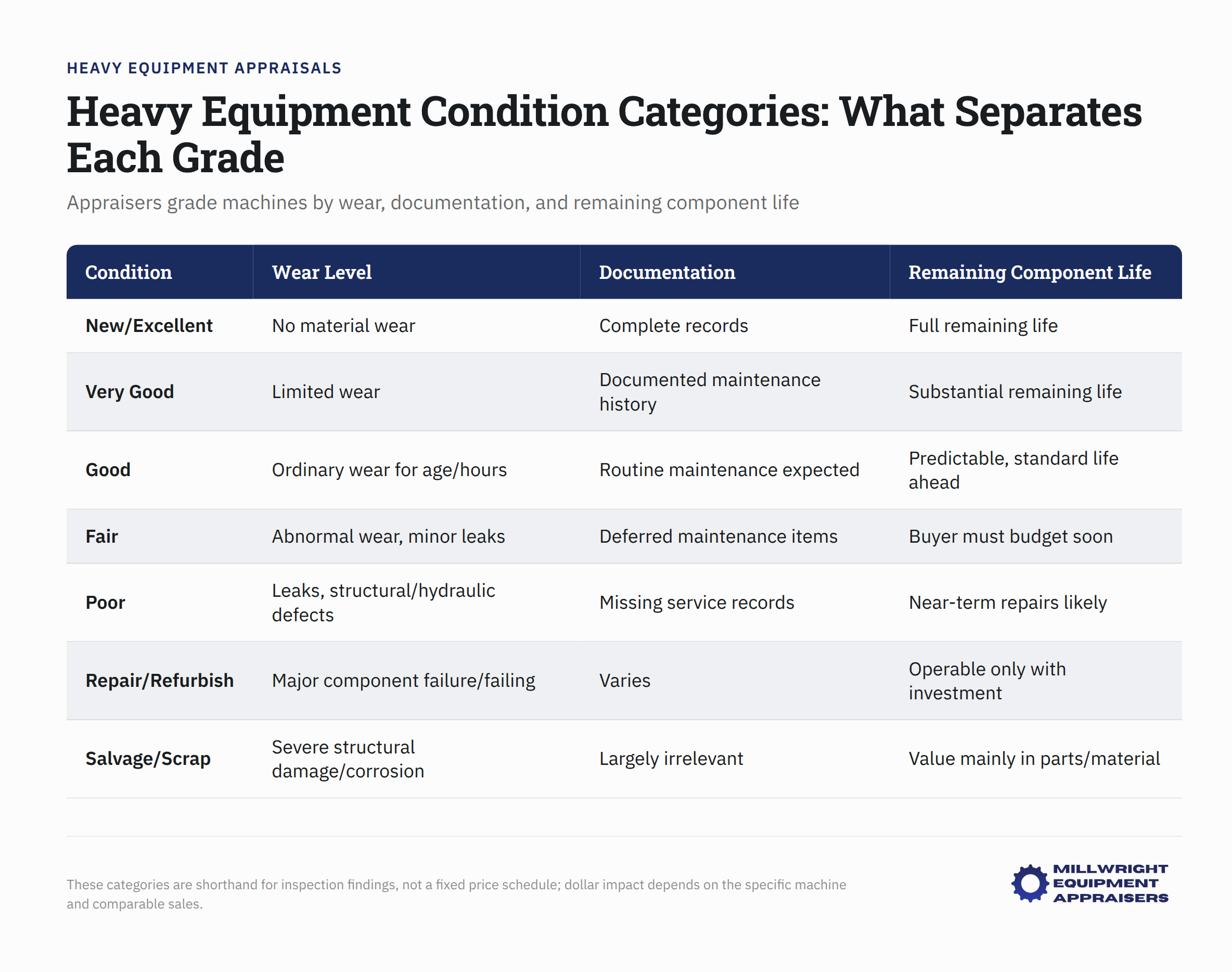
Appraisers sort machines into a small set of condition categories, and each one maps to a different expectation of remaining service life and near-term repair cost.
- New / Excellent: No material wear, full remaining component life, complete documentation. Rare outside of recently purchased units.
- Very Good: Documented maintenance history, limited wear, no structural or hydraulic defects, and substantial remaining life in major components.
- Good: Ordinary wear consistent with age and hours. Operational, with predictable, routine maintenance needs ahead.
- Fair: Some abnormal wear, minor leaks, or deferred maintenance items that a buyer would need to budget for soon.
- Poor: Leaks, structural or hydraulic defects, missing service records, or repairs that are likely needed in the near term.
- Repair / Refurbish: Major components have failed or are failing; the machine is operable only with near-term investment.
- Salvage / Scrap: Severe structural damage, major component failure, or corrosion to the point that the machine's value is largely in parts or material content.
These categories are not an industry-wide price schedule where "Good" always equals a fixed percentage of replacement cost. They're a shorthand for communicating inspection findings, and the dollar impact of moving from one category to the next depends entirely on the specific machine and what comparable sales show for units in similar condition.
What Appraisers Physically Inspect Beyond the Meter
A condition grade is only as good as the inspection behind it. When our appraisers evaluate a machine, the hour meter is one data point among several, and it's weighed against direct physical evidence.
Hydraulic performance gets checked for cylinder drift, slow or jerky response, and visible leaks at hoses, fittings, and seals. A cylinder that drifts under load points to internal seal wear that a buyer will discount heavily, regardless of what the hour meter says.
Undercarriage, tracks, and tires are measured and compared to manufacturer wear limits. On tracked machines, that means checking sprocket, idler, and roller wear alongside track tension and pad condition. On wheeled machines, it means tire tread depth, sidewall condition, and rim damage.
Structural integrity is inspected across the frame, boom, stick, and all major welds, looking for cracks, prior repairs, bent components, or signs of overload stress. A cracked weld that's been patched rather than properly repaired is a material finding, not a cosmetic one.
Powertrain response gets evaluated through a start-up and load test: smooth acceleration, clean shifting, normal exhaust color, and the absence of unusual noise or vibration under load.
Maintenance and service records round out the picture. A complete service history, with documented fluid changes, filter replacements, and component rebuilds, lets the appraiser corroborate the hour meter and understand exactly what's been done to the machine and when.
Pro tip: Keep every service receipt and inspection report in one file, by machine serial number, from the day you buy the equipment. A thin maintenance record is one of the most common reasons an otherwise solid machine grades lower than its owner expects.
How Hours and Condition Get Weighed Against Comps
For equipment with an active secondary market, the sales-comparison approach is usually the most direct path to a value conclusion. The process, in sequence, looks like this:
- Identify comparable sales of the same or closely similar make, model, age, and configuration.
- Normalize each sale for sale date, auction versus negotiated terms, attachments included, and freight.
- Adjust for hours and condition, using inspection findings rather than the meter reading alone.
- Adjust for market timing and location, since construction activity and demand can differ sharply between regions and years.
- Reconcile the adjusted comps into a single value conclusion under the appraisal's defined premise of value, whether that's fair market value or orderly liquidation value. (Our guide to fair market value versus orderly liquidation value walks through how that premise choice changes the number.)
This is also where USPAP comes in. Standard 7 of the Uniform Standards of Professional Appraisal Practice governs how an appraiser develops a personal property or machinery valuation, and it requires the appraiser to analyze the relevant characteristics of the subject, including condition and utilization, rather than relying on a single data point like the hour meter. The Appraisal Foundation publishes USPAP, and credentialed appraisers (through organizations such as the ASA, CAGA, and NEBB) are trained to apply it consistently across asset types.
This is the step where hours and condition genuinely interact instead of acting as separate line items. A higher-hour machine with full service records and recently rebuilt major components can appraise higher than a lower-hour machine that's been neglected, because the higher-hour unit has more verified remaining life in the parts that actually fail. Tax depreciation schedules don't capture this nuance: IRS Publication 946 and the IRS definition of depreciable property exist to recover cost for tax purposes, and useful life for accounting purposes reflects factors like physical wear and technological change, according to general depreciation guidance. None of that establishes what a specific excavator will fetch at auction next month.
A Worked Example: Two Excavators, Same Age, Different Outcomes
Example: Two 2019 mid-size excavators come up for appraisal in the same region within a few weeks of each other.
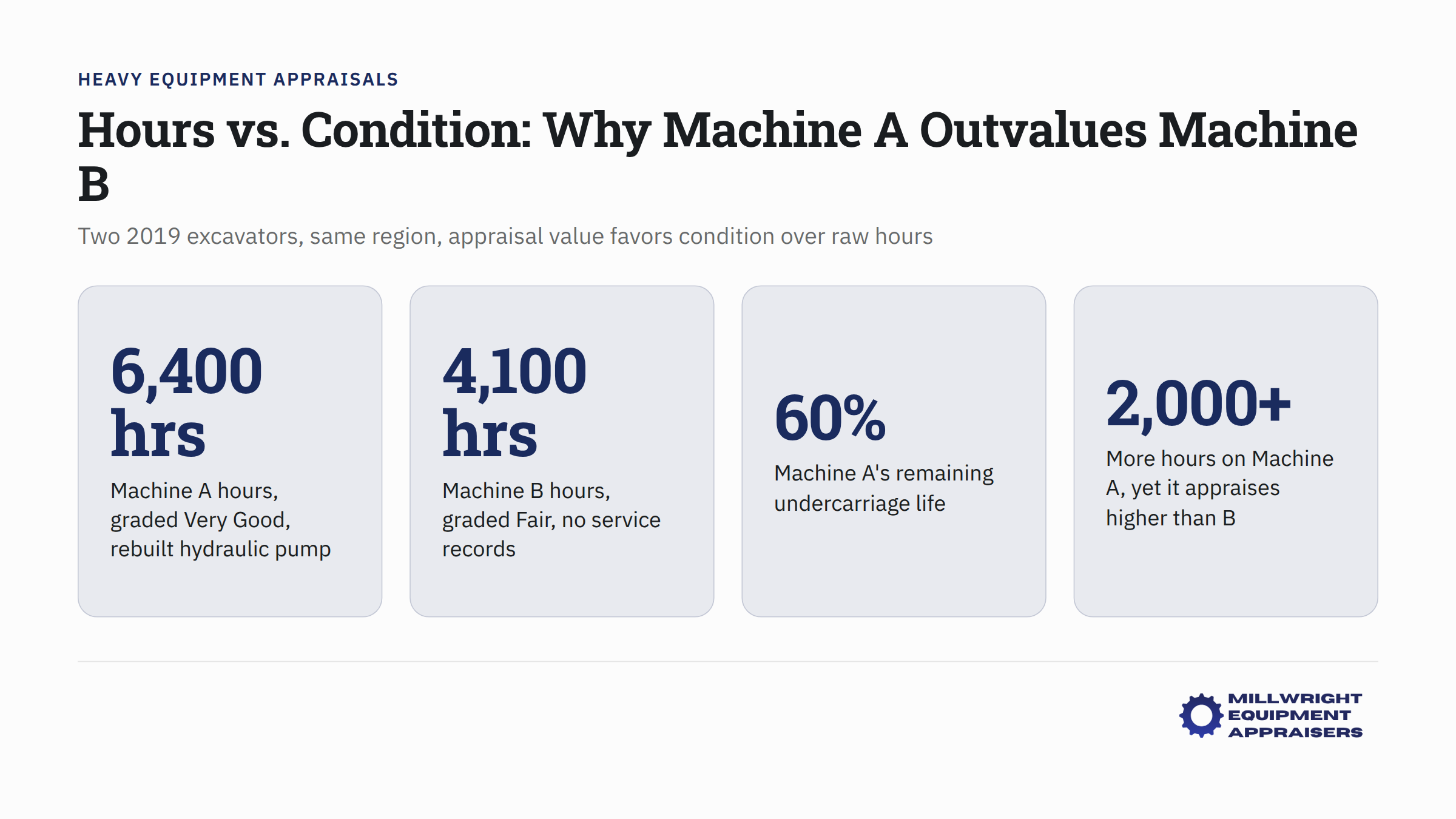
Machine A shows 6,400 hours. It has a complete service file, a recently rebuilt hydraulic pump, new final drives at 5,800 hours, and tight pins throughout. The undercarriage is at roughly 60% remaining life. No cracks or structural repairs are found. The appraiser grades it Very Good.
Machine B shows 4,100 hours. There are no service records. The undercarriage shows wear consistent with 7,000 to 8,000 hours of use, the bucket pins have visible play, and there's a cylinder with noticeable drift on the stick. The appraiser grades it Fair, and notes the mismatch between the stated hours and the observed wear as a factor in the adjustment.
Using recent comparable sales of similar machines in Very Good and Fair condition, Machine A appraises meaningfully higher than Machine B, despite having over 2,000 more hours on the clock. The comps for Very Good condition units support a stronger price, and Machine A's documented component rebuilds further support treating its effective remaining life as better than the raw hour count would suggest. Machine B's unverifiable hours and inspection findings push it toward the lower end of the comparable range instead.
A Practical Checklist to Sanity-Check Your Machine Before an Appraisal
Before you commission a formal appraisal, you can get a reasonable read on where your machine likely falls by working through the same evidence an appraiser would gather:
- Pull your service records by serial number and organize them chronologically, noting any major component replacements or rebuilds.
- Compare wear points to the hour meter: pedals, seat, pins, bushings, and undercarriage or tires. Flag anything that looks inconsistent with the stated hours.
- Run the machine under load and note any hesitation, unusual noise, smoke color, or slow hydraulic response.
- Check cylinders for drift by raising an attachment, holding it, and watching for creep over a minute or two.
- Inspect the frame, boom, and stick for cracks, repaired welds, or visible bending, particularly at stress points.
- Photograph everything, including the hour meter, serial number plate, undercarriage, and any defects, with a timestamp.
- Look up recent comparable sales for the same make, model, and approximate age to get a rough sense of the current market range.
Watch out: A machine that "runs fine" is not the same as a machine in good condition. Plenty of equipment with failing hydraulics or worn undercarriage will still start, move, and lift on the day you check it. The defects show up in cycle time, fuel burn, and comparable resale prices, not necessarily in a quick walk-around.
Running through this checklist won't replace a formal appraisal, but it will tell you roughly where your machine sits and help you spot surprises before an appraiser does. For questions specific to how valuation methods apply to your equipment, our FAQ on finding the value of heavy equipment covers related scenarios in more depth.
When you're ready for a defensible, USPAP-compliant number, whether for a sale, loan collateral, insurance, or a dispute, request a heavy equipment appraisal and our team will scope the assignment, inspect the machine, and reconcile the hours, condition, and comparable sales into a supportable conclusion of value.